Bug #80739 [Com]: PHP-FPM status page shows listen queue 0
| From: | phpbugs at icounsellor dot co dot uk | Date: | Mon, 08 Nov 2021 13:45:01 +0000 |
| Subject: | Bug #80739 [Com]: PHP-FPM status page shows listen queue 0 | ||
| References: | 1 | Groups: | php.bugs |
| Request: | Send a blank email to php-bugs+get-237606@lists.php.net to get a copy of this message | ||
Edit report at https://bugs.php.net/bug.php?id=80739&edit=1
ID: 80739
Comment by: phpbugs at icounsellor dot co dot uk
Reported by: micha at dietpi dot com
Summary: PHP-FPM status page shows listen queue 0
Status: Open
Type: Bug
Package: FPM related
Operating System: Debian Bullseye
PHP Version: 8.0.10
Block user comment: N
Private report: N
New Comment:
Further to Micha's comment:
>> I'll now monitor whether "Recv-Q" is ever different from zero.
This weekend I wrote a quick-and-dirty set of scripts to see if Micha's plan would show
positive results (details below).
RESULTS:
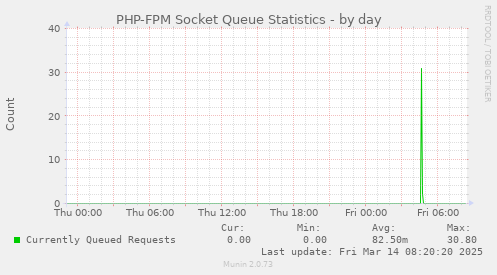
Day: https://icounsellor.co.uk/phpbugs/phpfpm_queue-day.png
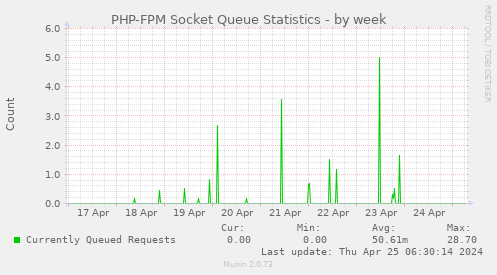
Week: https://icounsellor.co.uk/phpbugs/phpfpm_queue-week.png
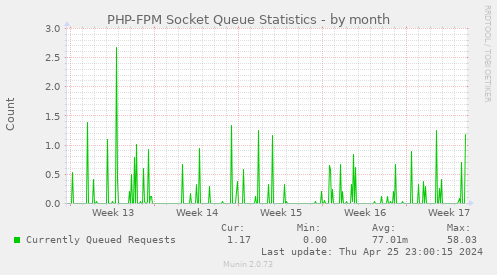
Month: https://icounsellor.co.uk/phpbugs/phpfpm_queue-month.png
(These URLs are soft-linked to my live Munin data)
CONCLUSION: Although my PHP-FPM site is of low activity, we do have positive results here showing we
can get the value of Receive-Q on Linux
RECOMMENDATION: As Micha suggests earlier, the PHP Development Team will be able to gain knowledge
from Linux source code (reference: https://serverfault.com/a/930677/577419 -
internals of "ss") to attain the "how to" with respect to gaining Receive-Q data
for PHP-FPM.
--------------------------------
FYI - SCRIPTS.
SCRIPT #1: Quick & Dirty Bash Script to collate maximum Receive-Q value for php-fpm7.4.
Purpose: Munin runs only once every 5 minutes so asking it to call ss to show receive-q values for
php-fpm once every 5 minutes isn't very detailed. Hence, this script runs (... repeatedly via
cron) collating, once a second, the maximum value of phpfpm-7.4 Receive-Q via ss (in periods of 5
minutes).
Source:
#!/bin/bash
FileRoot="php7.4-fpm";
Socket=$FileRoot".sock";
LoopDelay=1;
SharedFile="/dev/shm/"$FileRoot".count";
# Run for 5 minutes... then quit
let RunLoop=300/$LoopDelay;
COUNTER=0
Max=0;
if [ ! -f $SharedFile ]; then
# https://unix.stackexchange.com/questions/107038/obtain-exclusive-read-write-lock-on-a-file-for-atomic-updates
flock -x -w 5 $SharedFile echo 0 > $SharedFile;
fi
while [ $COUNTER -lt $RunLoop ]; do
SendQCount=$(ss -ln | grep $Socket | awk '{print $3}');
if (( SendQCount > Max )); then
Max=$SendQCount;
fi
sleep $LoopDelay;
let COUNTER=COUNTER+1;
done
# Write the latest results...
flock -x -w 5 $SharedFile echo $Max > $SharedFile;
-----
SCRIPT #2: Quick and Dirty Munin plugin
Purpose: Munin-node calls this script, reads the data left by the above script (once every 5
minutes), and graphs the information
Source:
#!/bin/bash
if [ "$1" = "config" ]; then
MaxQueue=$(ss -ln | grep php7.4-fpm.sock | awk '{print $4}');
echo 'graph_title PHP-FPM Socket Queue Statistics'
echo 'graph_vlabel Count'
echo 'graph_category php'
echo "graph_info This graph counts the number connections queued. Max queue configured
to be: "$MaxQueue
echo "Current.label Currently Queued Requests";
exit 0
fi
CurrentQueue=$(cat /dev/shm/php7.4-fpm.count);
echo Current.value $CurrentQueue;
exit 0;
Previous Comments:
------------------------------------------------------------------------
[2021-09-16 12:27:49] micha at dietpi dot com
Indeed SO_LISTENINCQLEN seems to not exist on Linux: https://manpages.debian.org/bullseye/manpages/socket.7.en.html#Socket_options
I tried to find out other ways to get current and max queue length on Linux: https://serverfault.com/a/930677/577419
```
# ss -lx | sed -n '1p;/php/p'
Netid State Recv-Q Send-Q Local Address:Port Peer Address:Port
Process
u_str LISTEN 0 1024 /run/php/php8.0-fpm.sock 157408202 * 0
```
If I understood it right, this means current queue length is zero and max is 1024? The latter is
true, changing "listen.backlog" to 2048 makes "Send-Q" change accordingly.
I'll now monitor whether "Recv-Q" is ever different from zero. Checking the internals
of "ss" may then provide the options for the FPM as well, I hope.
Best regards,
Micha
------------------------------------------------------------------------
[2021-05-28 02:02:23] yuta at adachi dot life
I reproduced this as well. Checking the implementation, we see that "getsockopt" is used
for getting the queue length. We can use the "SO_LISTENINCQLEN" option in FreeBSD to get
the status of the UNIX domain socket, but I think there is no option in Linux to get it.
https://github.com/php/php-src/blob/php-8.0.6/sapi/fpm/fpm/fpm_sockets.c#L487-L563
The original implementation did not support UNIX domain sockets, so I suppose this is more of an
undocumented specification than a but.
http://svn.php.net/viewvc/php/php-src/branches/PHP_5_4/sapi/fpm/fpm/fpm_sockets.c?sortby=date&r1=305266&r2=305267&pathrev=312922&
We can use "netlink" to get the status of all sockets, but I think there are some
privilege and performance concerns. Any ideas?
------------------------------------------------------------------------
[2021-02-12 15:21:52] micha at dietpi dot com
Description:
------------
I enabled the PHP-FPM status page and configured a handler in Apache2:
```
<Location /status>
SetHandler "proxy:unix:/run/php/php8.0-fpm.sock|fcgi://localhost/status"
</Location>
```
This is the result:
```
pool: www
process manager: static
start time: 28/Jan/2021:15:53:44 +0100
start since: 1147547
accepted conn: 1054191
listen queue: 0
max listen queue: 0
listen queue len: 0
idle processes: 11
active processes: 1
total processes: 12
max active processes: 12
max children reached: 0
slow requests: 0
```
As can be seen, while all running processes have been used concurrently (this is the case after a
few hours already, so not a very rare event), the listen queue stays at zero. Especially the
listen queue len stays at zero, even that listen.backlog = 1024 is applied
in the pool configuration and as well system-wide a sufficient backlog is permitted:
```
net.core.somaxconn = 2048
net.ipv4.tcp_max_syn_backlog = 1024
```
This is on PHP8.0.2, but it was the same before on PHP8.0.1 and PHP7.4.
Steps to reproduce the behavior:
1. Install Debian Bullseye
2. Install Apache2 and PHP-FPM
3. Enable the PHP-FPM status page and the related handler in Apache2
4. Cause more concurrent requests than pm.max_children
5. Watch PHP-FPM status page to show listen queue len and max listen queue
being zero.
Probably related bug report: https://bugs.php.net/bug.php?id=76323
Expected result:
----------------
I would expect that listen queue len matches listen.backlog and that I do
see a non-zero value at max listen queue, when the process limit is hit regularly. But
probably in this setup it is handled differently? At least connections are not dropped from what I
can say, no related error messages appear in either PHP or Apache2 logs, so in fact requests are
queried somewhere.
Actual result:
--------------
listen queue: 0
max listen queue: 0
listen queue len: 0
------------------------------------------------------------------------
--
Edit this bug report at https://bugs.php.net/bug.php?id=80739&edit=1