Re: Re: [RFC] [DISCUSSION] pecl_http
| From: | Michael Wallner | Date: | Thu, 05 Feb 2015 20:09:37 +0000 |
| Subject: | Re: Re: [RFC] [DISCUSSION] pecl_http | ||
| References: | 1 2 3 4 5 | Groups: | php.internals |
| Request: | Send a blank email to internals+get-81960@lists.php.net to get a copy of this message | ||
Hi Pierre!
On 05/02/15 18:49, Pierre Joye wrote:
>
> On Feb 5, 2015 3:17 PM, "Michael Wallner" <mike@php.net
> <mailto:mike@php.net>> wrote:
>>
>> Compare the timings accessing google 20 times sequentually:
>>
>> With default of raphf.persistent_handle.limit=-1 (unlimited):
>> █ mike@smugmug:~$ time php -r 'for ($i=0;$i<20;++$i) {(new
>> http\Client("curl","google"))->enqueue(new
>> http\Client\Request("GET",
>> "http://www.google.at/"))->send();}'
>>
>> 0.03s user 0.01s system 2% cpu 1.530 total
>>
>>
>> With raphf effectively disabled:
>> █ mike@smugmug:~$ time php -d raphf.persistent_handle.limit=0 -r 'for
>> ($i=0;$i<20;++$i) {(new
>> http\Client("curl","google"))->enqueue(new
>> http\Client\Request("GET", "
>>http://www.google.at/"))->send();}'
>>
>> 0.04s user 0.01s system 1% cpu 2.790 total
>
> While I like the idea, I would not take it as it. Many things could
> affect it and I am not sure the persistent resource is what spare times.
> Any profiling info with delta?
>
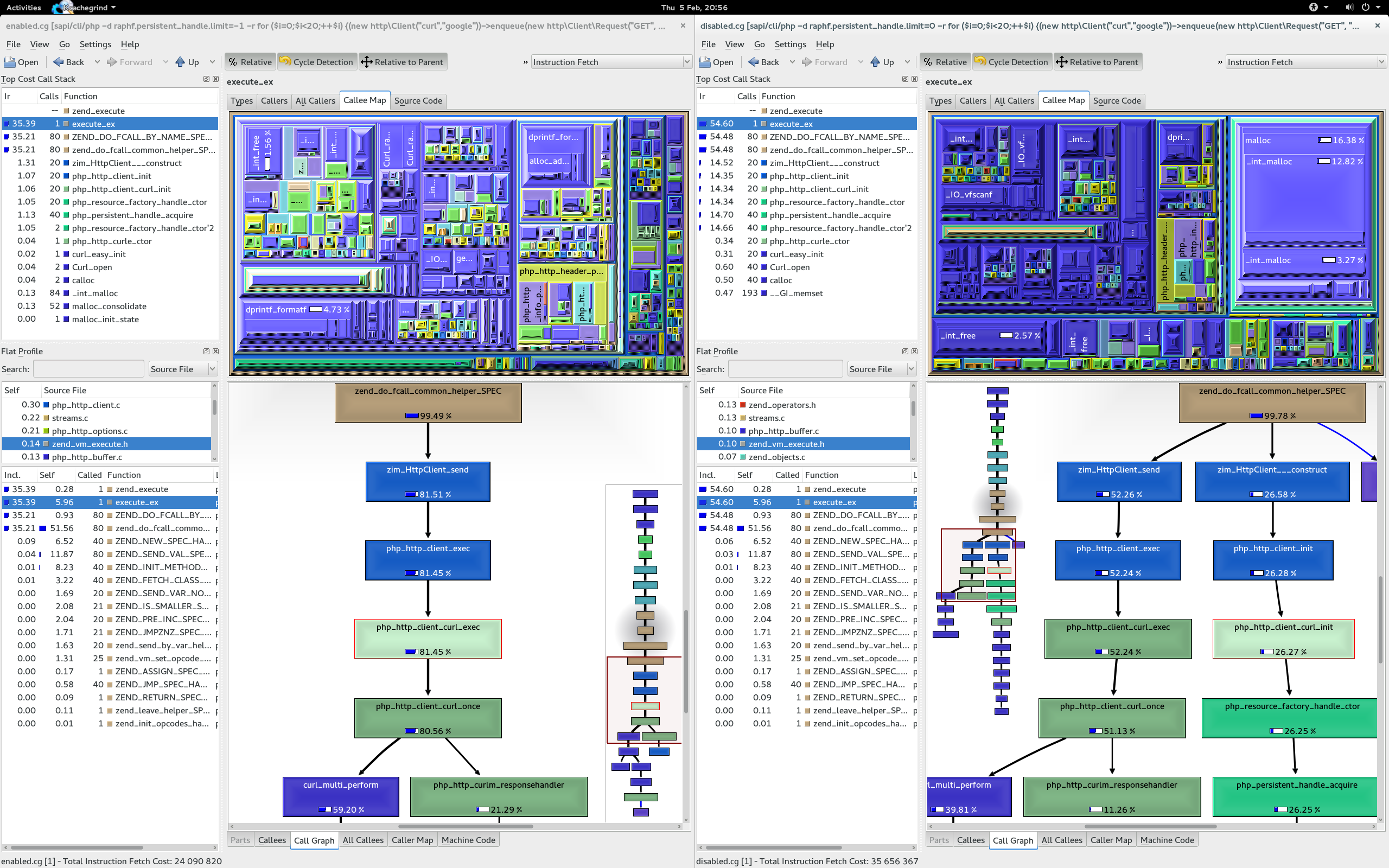
Does the following kcachegrind screenshot give an idea (I used a minimum
node cost of 10% to simplify the graph)?
Left is raphf enabled (24M Ir) and on the right raphf disabled (35M Ir):
http://dev.iworks.at/ext-http/raphf.png
Have a look on the top-most far-right highlighted block, which is solely
devoted to tearing up curl instances when raphf is disabled.
--
Regards,
Mike